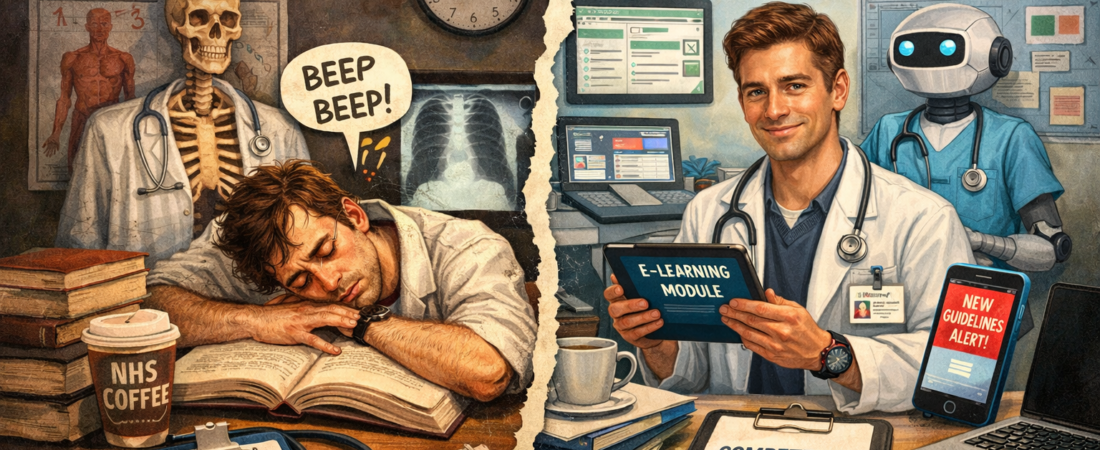
Thirty years ago, arriving at medical school in London felt a bit like being dropped into a Victorian novel with fluorescent lighting. There were anatomy labs that smelt permanently of formalin, lecturers who spoke in Latin without irony, and a quiet, shared suspicion that nobody really knew what was going on — including us.
Since then, medical training in the UK has transformed so thoroughly that today’s students might struggle to recognise the world we inhabited — a world of dog-eared textbooks, handwritten notes, and ward rounds that felt like competitive sport.
Then: Knowledge Was King (And Sleep Was Optional)
In the 1990s, the early years of medical school were dominated by information. Vast, unapologetic quantities of it. The goal appeared to be simple: absorb everything. Whether you understood it was secondary. Whether you would ever use it was immaterial.
Clinical exposure often came later, and when it did, it was frequently unstructured. You attached yourself to a hospital “firm,” followed your seniors like an eager but underqualified shadow, and hoped learning would occur by osmosis. Sometimes it did. Sometimes you just held retractors.
Today, undergraduate training is shaped by guidance from the General Medical Council, which has steadily shifted medical education toward clearly defined competencies. Students are assessed not only on what they know, but on how they communicate, reason, behave professionally, and work in teams. They meet patients earlier. They practise consultation skills deliberately. Reflection is encouraged — sometimes relentlessly.
Where we memorised cranial nerves out of fear, today’s students discuss patient-centred care before they’ve fully mastered tying a surgical knot.
The Great Reshuffle: Modernising Medical Careers
Perhaps the biggest shift came after graduation. In our day, newly minted doctors entered a system that felt loosely organised but intensely immersive. You became a Pre-Registration House Officer and learned very quickly that sleep was negotiable. Senior House Officer posts followed, sometimes in a meandering fashion. Careers developed, but not always along straight lines.
In 2005, everything changed with Modernising Medical Careers. The aim was admirable: create a structured, transparent training pathway. The result was the UK Foundation Programme — two formal years (FY1 and FY2) with defined competencies, supervised assessments, and electronic portfolios that record everything except perhaps your caffeine intake.
Progression now leads into specialty training programmes culminating in a Certificate of Completion of Training. There are forms. There are panels. There are acronyms. There are many, many acronyms.
Compared with our comparatively improvised route to consultancy, today’s system resembles a carefully signposted motorway. Ours felt more like a scenic country road — occasionally beautiful, occasionally alarming, and sometimes missing a signpost altogether.
Working Hours: The End of the 36-Hour Badge of Honour
One of the most dramatic cultural shifts has been working hours. Thirty years ago, heroic fatigue was practically a rite of passage. If you hadn’t worked through the night at least twice in one week, were you even trying?
European working time regulations (and subsequent UK rules) capped hours and enforced rest periods. Objectively, this has improved safety and wellbeing. Subjectively, some senior doctors still reminisce about “character-building” shifts that would now require a formal incident report.
Training today is safer, more humane — and arguably more fragmented, because fewer hours mean fewer continuous experiences with the same patients. The old firm structure fostered continuity and loyalty. The modern rota fosters compliance and spreadsheets.
Technology: Goodbye Pagers, Hello Portfolios
Our cohort relied on pagers that beeped with theatrical timing — usually when you had just sat down. Notes were paper. Results required physical retrieval. Guidelines lived in ring binders.
Today’s trainees carry powerful computers in their pockets. Electronic patient records, digital imaging, online prescribing systems, and virtual learning platforms are routine. Assessments are logged electronically. Feedback is documented. Reflection is uploaded.
Even artificial intelligence is edging into diagnostics and decision support — something that would have sounded like science fiction when we were wrestling with overhead projectors.
More Structured — But Also More Competitive
Medical school places have expanded, and the NHS has grown more complex. Yet competition for specialty training posts has intensified. Completing medical school no longer guarantees a smooth ascent into your chosen field. The path is clearer — but also narrower.
In many ways, training is fairer, more standardised, and more accountable than when we began. But it is also more scrutinised, more documented, and arguably less forgiving of wandering curiosity.
Looking back, it’s tempting to romanticise our era — the camaraderie of the firm, the shared confusion of anatomy labs, the absurd bravado of night shifts fuelled by vending-machine coffee. But the truth is that medical training has evolved in response to real needs: patient safety, transparency, wellbeing, and fairness.
The students arriving in London today are different — but so is the world they are preparing to serve.
And if they seem calmer than we were in first year, it may simply be because their assessments are competency-based — rather than terror-based.